

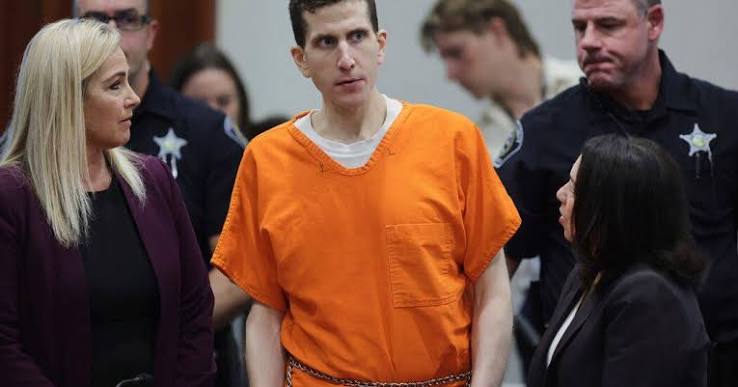
You are about to learn who Bryan Kohberger is, what happened in the case that made him a household name, and why he is back in the news this week. He is trying to take back the guilty plea that kept him off death row, and that filing just became public.
Background: Who Is Bryan Kohberger?
Bryan Kohberger is a former criminology graduate student who was arrested in December 2022 and later pleaded guilty to murdering four University of Idaho students. The killings happened in the early morning hours of November 13, 2022, inside an off-campus rental house in Moscow, Idaho. The victims were Madison Mogen and Kaylee Goncalves, both 21, Xana Kernodle, 20, and Ethan Chapin, 20.
People search his name because this became one of the most closely watched criminal cases in the country. It involved a long manhunt, DNA evidence from a knife sheath left at the scene, and a plea deal that avoided a trial many expected to last months and draw national media attention throughout. Investigators used genetic genealogy techniques, similar to methods used in other cold case investigations, to help narrow down a suspect after analyzing DNA left behind at the crime scene. He is trending again now because he just tried to reverse course on the plea deal that had, until this week, appeared to close the case for good.
Latest Update
Kohberger filed a “petition for post-conviction relief” in Ada County District Court on July 27, 2026. This is a separate legal process from a normal appeal, and it is the route he has left open since he waived his right to a direct appeal as part of his plea deal. In the filing, he claims he was “convinced to falsely confess” and says his defense team failed to tell him about evidence that could have helped his case.
Legal experts note that winning a post-conviction relief case is rare, and Kohberger would likely need to prove his own legal team performed poorly, not just that he changed his mind. A 2019 U.S. Supreme Court decision, Garza v. Idaho, does allow defendants to raise certain Sixth Amendment claims even after waiving standard appeal rights, which is part of why this filing is legally possible at all. Idaho prosecutors have not yet filed a public response to the new petition as of this date. No court date for a hearing on the petition has been confirmed yet, so anything beyond the filing itself remains unconfirmed.
Here is what this filing is not: it is not a new trial, and it does not release Kohberger from custody while it is being reviewed. A judge first has to decide whether the petition even has enough legal grounds to move forward before anything else can happen in the case.
Case Profile
Background and Education
Before his arrest, Kohberger was a Ph.D. student in criminology at Washington State University, located roughly ten miles from the University of Idaho campus where the murders occurred. He had earlier studied criminal justice at DeSales University in Pennsylvania.
Arrest and Investigation
Investigators connected Kohberger to the crime scene using DNA recovered from a knife sheath found in bed with two of the victims, along with cell phone location data placing his phone near the house and surveillance footage of a vehicle matching his car near the scene. Records also showed his phone went dark for roughly two hours during the time of the killings, which prosecutors planned to argue was evidence he had turned it off deliberately. He was arrested at his parents’ home in Pennsylvania in December 2022, about six weeks after the killings, following a cross-country investigation that spanned multiple states.
Age
Kohberger is 31 years old, based on reporting tied to his arrest and sentencing dates.
Legal Proceedings and Plea
In July 2025, Kohberger pleaded guilty to four counts of first-degree murder and one count of burglary, in a deal that removed the death penalty as a possible sentence. Both of his parents were present in the courtroom when the plea was entered.
Sentencing
He was sentenced later that same month to four consecutive life sentences without the possibility of parole, plus ten additional years for the burglary charge. As part of the agreement, he waived his right to appeal the conviction directly.
Current Status
Kohberger is being held at an Idaho maximum security prison in Kuna, near Boise. He is representing himself in the new post-conviction filing, according to Ada County court records.
Family
Public reporting confirms his parents attended his plea hearing, but the case coverage has largely kept details about his broader family life out of the public record, so nothing beyond that is stated here.
Motive
Kohberger has never publicly stated a motive for the killings, and he was not legally required to provide one as part of his plea deal. Any claim about a specific motive that is not sourced to him directly or to court filings should be treated as unconfirmed.
✅ Quick fact check: Every detail above traces back to court filings or named news outlets reporting directly on the case. Where something has not been proven in court, such as a motive, we said so instead of guessing.
Case Timeline
| Date | Event |
|---|---|
| November 13, 2022 | Four University of Idaho students found killed in an off-campus home in Moscow, Idaho |
| December 30, 2022 | Bryan Kohberger arrested at his parents’ home in Pennsylvania |
| September 2023 | Kohberger’s defense team challenges DNA evidence and search warrants |
| July 2, 2025 | Kohberger pleads guilty to four counts of first-degree murder and one burglary count |
| July 23, 2025 | Sentenced to four consecutive life terms without parole, plus 10 years |
| July 27, 2026 | Files petition for post-conviction relief, claims his plea was coerced |
Reader Questions (FAQ)
Is Bryan Kohberger trying to get out of prison?
Not exactly. He is trying to withdraw his guilty plea through a petition for post-conviction relief, which could reopen the case and lead to a new trial, but it would not release him from custody in the meantime.
Why did Bryan Kohberger plead guilty if he says he is innocent now?
He pleaded guilty in July 2025 as part of a deal that removed the death penalty as a sentencing option. He now claims that plea was based on false promises and incomplete information from his defense team, though this claim has not been proven in court.
What is post-conviction relief?
It is a legal process used to challenge a conviction outside the normal appeals system, often based on claims like poor legal representation or new evidence. It is separate from the direct appeal that Kohberger waived as part of his plea agreement.
How many people did Bryan Kohberger kill?
He pleaded guilty to killing four University of Idaho students: Madison Mogen, Kaylee Goncalves, Xana Kernodle, and Ethan Chapin. All four died in the same November 2022 attack.
Where is Bryan Kohberger being held?
He is serving his sentence at a maximum security prison in Kuna, Idaho, near Boise, according to Idaho Department of Correction records cited in recent reporting.
Could Bryan Kohberger face the death penalty again?
In his statement to the New York Times, Kohberger said prosecutors could seek the death penalty again if his plea is thrown out. Whether that would actually happen depends on how the courts rule on his petition, which is not yet decided.
⚠️ A note on accuracy: This is an active legal filing, not a settled outcome. Claims made in Kohberger’s own petition, including that his plea was coerced, are his allegations and have not been ruled on by a court as of this date.
Wrap-Up
Bryan Kohberger’s case looked closed a year ago, when he stood in an Idaho courtroom and told a judge, under oath, that he was pleading guilty because he was guilty. That closure did not hold. His new petition puts the case back into an uncertain legal process, one that legal experts describe as difficult to win, since courts do not often reopen a conviction just because a defendant changed his account.
For the families of Madison Mogen, Kaylee Goncalves, Xana Kernodle, and Ethan Chapin, this filing means a case they may have believed was settled is not fully behind them. Court records show the filing caught some relatives by surprise, since Kohberger had made no public statements suggesting he planned to challenge his plea before the petition appeared this week.
It also raises a broader question that shows up in other high-profile plea deals: how much finality a guilty plea actually guarantees when a defendant later changes their account under oath. Courts generally hold defendants to statements made during a plea hearing precisely because reversing course afterward is supposed to be difficult, not routine. Whether Kohberger’s petition clears that bar is now up to a judge in Ada County, not to public opinion or media coverage.
As this moves through the Ada County court system, the facts that matter most are the ones on the record: what was filed, what a judge decides, and what prosecutors say next. This page will be updated to reflect only what is confirmed through court filings and credible reporting, not speculation about how the case will end.

John Wood is the founder and lead editor of Biography Region. He researches and writes accurate, engaging biographies of celebrities, entrepreneurs, influencers, and public figures, delivering well-sourced, reader-focused content that informs and inspires.