

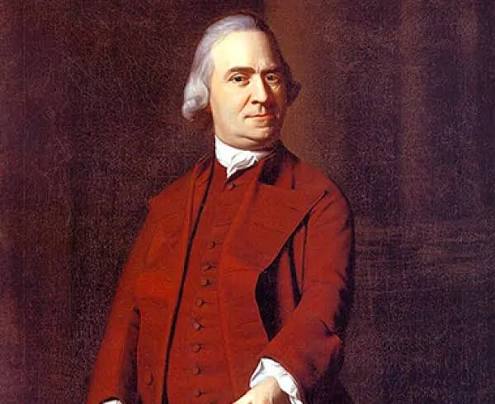
Samuel Adams failed at nearly every business he tried before finding his real skill: organizing people against British policy. This life story covers his shaky early career, his role in events like the Boston Tea Party, and his later political life.
Background
Samuel Adams shows up in searches often because of his connection to the Boston Tea Party and his cousin relationship to John Adams, which sometimes causes confusion between the two men. People searching his name usually want to untangle who he actually was and what he specifically did.
Latest Update
As of August 2026, Samuel Adams’ historical role continues to be highlighted mainly through Boston-area historical sites and Revolutionary War educational programming. No new biographical development has recently emerged; ongoing public interest is largely tied to his association with the Boston Tea Party and to the beer brand that borrows his name, which is unrelated to any of his own family’s business ventures.
Full Profile
Family and Early Life
Adams was born in Boston in 1722 to a well-established family involved in the malting business (brewing-related trade). Despite this background, Samuel struggled financially for most of his early adulthood, failing at several business attempts including managing his father’s malt house.
Career Path
After his business failures, Adams found his real strength in political organizing. He became a leading voice against British taxation policies, helped organize the Sons of Liberty, and is widely credited as a key planner behind the 1773 Boston Tea Party. He later served in the Continental Congress, signed the Declaration of Independence, and served as Governor of Massachusetts later in life.
Age
Samuel Adams lived to age 81, born September 27, 1722, and dying October 2, 1803.
Religion
Adams was a devout Congregationalist, and his religious convictions often shaped his political rhetoric about liberty and moral duty.
Spouse/Partner
Adams married twice: first to Elizabeth Checkley in 1749, who died in 1757, and later to Elizabeth Wells in 1764.
Net Worth
Adams was famously poor for much of his life due to repeated business failures and his focus on political organizing rather than personal finances. A specific modern-equivalent net worth is not documented and would be speculative.
Parents
His father was Samuel Adams Sr., a prosperous maltster and local politician, and his mother was Mary Fifield.
Height
No consistently documented height records exist for Samuel Adams; physical descriptions from the period are limited.
Education
Adams graduated from Harvard College in 1740 and later earned a master’s degree there as well, giving him a strong formal education despite his later business struggles.
Hometown/State of Origin
Adams was born and lived most of his life in Boston, Massachusetts.
Official/Archival Link
Massachusetts Historical Society: Samuel Adams Collections
Legacy and Lasting Impact
Samuel Adams’ organizing legacy is often overshadowed today by more visible Founders, but his early network-building through groups like the Sons of Liberty established organizing patterns, coordinated protest, shared messaging, and cross-colony communication, that later movements in American history have echoed.
His post-independence work as Massachusetts governor, while less remembered than his revolutionary organizing, also shows a consistent throughline in his career: using formal and informal political structures to advance the causes he believed in, whether that meant protesting a king or governing a new state.
| Date | Event |
|---|---|
| 1722 | Born in Boston, Massachusetts |
| 1740 | Graduates from Harvard College |
| 1764-1765 | Becomes active in organizing resistance to British taxation |
| 1773 | Helps organize the Boston Tea Party |
| 1774-1781 | Serves in the Continental Congress |
| 1776 | Signs the Declaration of Independence |
| 1794-1797 | Serves as Governor of Massachusetts |
| 1803 | Dies in Boston |
Historical Context
Boston in the 1760s and 1770s functioned as one of the most politically active port cities in the colonies, with taverns, town meetings, and committees of correspondence all serving as informal organizing infrastructure that Samuel Adams used extensively to build and coordinate resistance to British policy.
His ability to work across these informal networks, rather than relying solely on formal political office, reflects a style of organizing that predates modern grassroots movements by roughly two centuries, using existing community gathering spaces to build coordinated political pressure.
Reader Questions (FAQ)
Is Samuel Adams related to John Adams?
Yes, they were second cousins. Samuel Adams was older and became prominent earlier in the revolutionary movement, while John Adams later became a Founding Father and second U.S. president.
Did Samuel Adams organize the Boston Tea Party?
He is widely credited as one of the key organizers, using groups like the Sons of Liberty to plan and carry out the 1773 protest against British tea taxes.
Was Samuel Adams good at business?
No. He struggled significantly in business, failing at ventures including running his family’s malt house, before shifting his focus entirely to political organizing.
Did Samuel Adams sign the Declaration of Independence?
Yes, he was a delegate to the Continental Congress and signed the Declaration of Independence in 1776.
Is the beer brand Samuel Adams connected to him directly?
The beer brand is named in his honor because of his Boston Tea Party association, but it was founded long after his death and has no direct business connection to his own family’s ventures.
Why do people still search for Samuel Adams today?
His central role organizing early resistance to British policy, plus the modern beer brand carrying his name, keeps him a frequently searched figure, even though his specific contributions are sometimes confused with those of his cousin John Adams.
What was the Sons of Liberty?
It was a colonial organization Samuel Adams helped build that coordinated resistance to British policies like the Stamp Act, using tactics including protests, boycotts, and public pressure campaigns.
Did Samuel Adams support the U.S. Constitution?
He was initially skeptical, sharing some Anti-Federalist concerns about centralized power, though he ultimately supported ratification in Massachusetts after amendments protecting individual rights were promised.
Did Samuel Adams attend the Constitutional Convention?
No, he was not a delegate to the 1787 Constitutional Convention in Philadelphia, though he participated actively in Massachusetts’ later ratification debate over the resulting Constitution.
What was Samuel Adams’ relationship with John Hancock?
The two worked closely together as prominent Massachusetts revolutionary leaders, though their relationship reportedly experienced periods of political tension as both navigated Massachusetts politics in the years following independence.
Wrap-Up
Samuel Adams’ life story is really a story about finding your actual skill after failing at what you were ‘supposed’ to do. He wasn’t a good businessman, but he turned out to be exceptional at organizing people around a shared grievance.
That organizing skill mattered enormously in the years leading up to the Revolution, when public opinion had to be built and sustained before any formal declarations or battles happened.
For readers today, Samuel Adams is a useful reminder that revolutions aren’t only won by writers and generals, they also depend on organizers working in the background, coordinating the people who show up.
His life story is a reminder that some of the most consequential figures in a movement are the ones doing the unglamorous coordination work, not always the ones giving the most famous speeches.
His cousin John Adams later wrote that Samuel Adams deserved more credit than he ultimately received for laying the early groundwork of colonial resistance, a sentiment historians have increasingly revisited as they reassess which figures did the foundational organizing work behind the Revolution’s more famous public moments.
It’s worth adding that Samuel Adams’ failures in business, while personally difficult at the time, may have inadvertently prepared him for his later political role. Having experienced financial hardship directly, he was arguably more attuned to the economic grievances driving broader colonial resistance to British taxation than wealthier contemporaries who experienced those same taxes as a more abstract inconvenience rather than a genuine financial threat to their livelihood.
That perspective is easy to overlook when his legacy gets reduced to a single famous protest, rather than years of patient, often unglamorous coalition building.
It also explains why his cousin John Adams, writing decades later, insisted that Samuel’s early organizing deserved far more historical credit than it typically received.
His example is often used today to illustrate that movements need both visible speakers and quieter coordinators working the same rooms, taverns, and committees behind them.
His story is a reminder that revolutions depend as much on patient network-building as they do on any single dramatic public moment.

John Wood is the founder and lead editor of Biography Region. He researches and writes accurate, engaging biographies of celebrities, entrepreneurs, influencers, and public figures, delivering well-sourced, reader-focused content that informs and inspires.